
Tech juggernaut Microsoft (MSFT) hasn’t exactly enjoyed an auspicious start to the new year. While the company’s software products represent must-haves in the academic and professional ecosystems, MSFT stock has failed to live up to its reliable self. As evidence, we can look to the Barchart Technical Opinion indicator, which currently rates shares as a 40% Sell. Still, there might be a contrarian opening for the adventurous.
Looking at a quick fundamental recap, MSFT stock arguably lost a lot of its appeal due to Microsoft and OpenAI revising their partnership. This move effectively ended the former’s exclusive hold on OpenAI’s technology. As a consequence, OpenAI now has greater freedom to sell its artificial-intelligence-based solutions to Microsoft’s biggest rivals. It also exposed potential dependency concerns that force MSFT to be value-adjusted.
Another major headwind is the massive capex sledgehammer of generative AI. With Microsoft entering an aggressive spending war for AI infrastructure, the impact to the bottom line has been conspicuous. Additionally, the tech giant’s myriad challenges — which have included AI hardware delays and datacenter expansion pauses — impose costs that rivals have better addressed.
Finally, these misfires have created doubts among investors regarding valuation skepticism. Even with the recent underperformance of MSFT stock, many question whether the AI premium is still too high given the current spending trajectory.
Despite the obvious risks, the smart money appears open to the idea of a contrarian trade.
Volatility Skew Provides a Key Sentiment Clue for MSFT Stock
While the smart money shouldn’t automatically be considered prescient, it’s completely understandable (and rational) to assume it the crystal ball bias. These market professionals have access to the best resources and information. They’re also likelier to be trading more upstream to key disclosures than public investors.
As such, when sophisticated market participants hedge their bets or acquire upside exposure at a greater magnitude than normal, that could very well be a useful sentiment signal. Essentially, that’s what the volatility skew is.
By definition, the skew identifies implied volatility (IV) across the strike price spectrum of a given options chain. Since IV represents an anticipation of greater movement, a higher IV reading suggests a higher premium undergirding the affected strike.
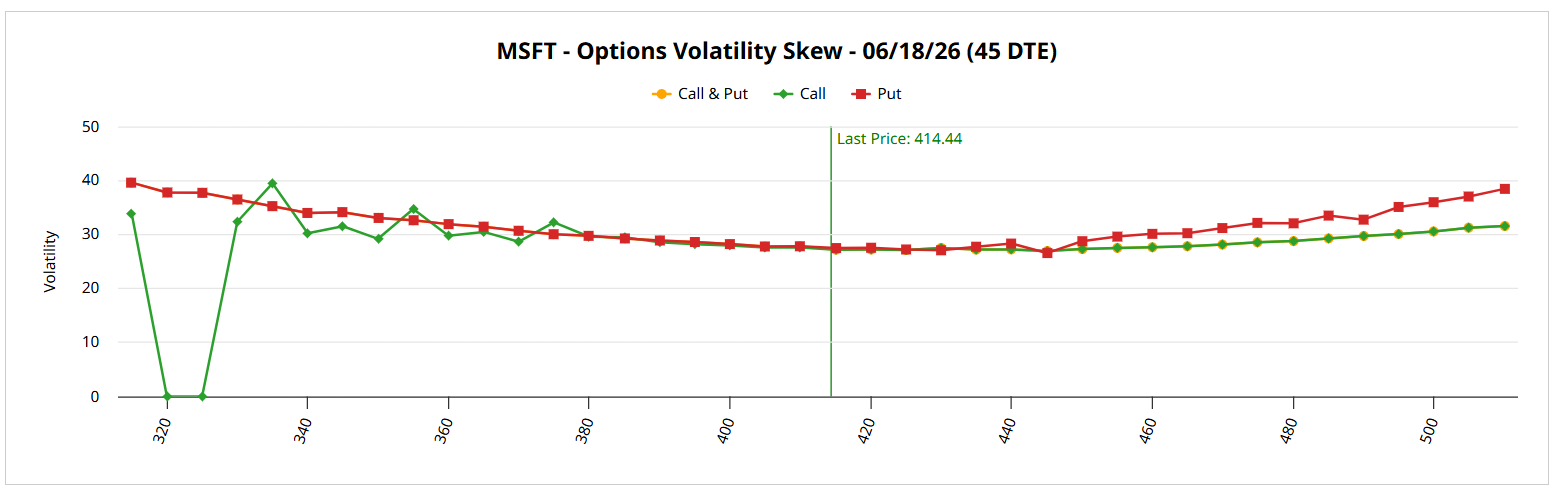
Using options jargon to explain these derivative contracts and their various screeners can get very confusing so it’s best to think of volatility skew as an insurance market. In the case of the June 18 expiration date for MSFT stock, the skew’s “smile” is broad across the spectrum. This dynamic indicates that there isn’t excessively pronounced demand for downside protection nor are traders aggressively hunting for upside convexity.
In the world of options, this skew is about as neutral as you can get — and to me, the neutrality in this context is more meaningful than just traders being middle of the road.
Since the start of the year, MSFT stock has been down more than 14%. Over the past 52 weeks, it slipped 5%. That’s not great for a company that practically bankrolled the modern AI era with its multi-billion-dollar investment in OpenAI in 2019. Therefore, if investors really are concerned about the first mover’s curse and the subsequent capex battle, the skew arguably should be much more pensive.
It’s not and that could be a small win for MSFT stock.
Using Inductive Probabilities to Trade Microsoft Stock
Although the volatility skew provides a structural snapshot of how the smart money is positioned, it doesn’t give us a probability of outcomes. In other words, the act of paying a higher premium for auto insurance doesn’t necessarily mean that an auto accident is more likely to occur. To get an idea of how we can take advantage of the skew, we can use inductive probabilities.
Let’s look at Microsoft stock on a weekly historical basis going back to January 2019. If you were to place a long position in MSFT now at the last closing price of $414.20, you would expect to be profitable 10 weeks later 69.7% of the time. This stat comes from a denominator of 363 rolling 10-week sequences, with 253 weeks rising above the starting price.
While the exceedance ratio is strongly positive, the expected return would be rather modest, with the forward 10-week distribution projected to land between $395 and $445. Probability density or the most common median outcome price will likely be around $425.
However, we’re not interested in trading Microsoft stock at random. Instead, we’re looking at the current signal, where in the last 10 weeks, MSFT printed only four up weeks but with an upward slope. Under this specific sequence, we may expect the forward distribution to stretch to between $380 and $460.
Yes, that means both the risk and reward profiles have been expanded, which may not seem desirable. But the key finding is that, under this signal, the probability density is very pronounced at $430. From this probabilistic inference, aggressive speculators may consider the 425/430 bull call spread expiring June 18.
Ideally, you’re looking for MSFT stock to rise through the $430 strike at expiration. If it does, the maximum payout is over 127%. Breakeven lands at $427.20, providing a narrow window of opportunity. However, with $430 being the most common median outcome, the above spread is intriguing.
On the date of publication, Josh Enomoto did not have (either directly or indirectly) positions in any of the securities mentioned in this article. All information and data in this article is solely for informational purposes. For more information please view the Barchart Disclosure Policy here.
More news from Barchart
- Ahead of Palantir Earnings, Here Is What Barchart Options Data Shows for PLTR Stock
- Huge, Unusual Volume of Amazon Options Trade Today - As AMZN Moves Up
- Why Microsoft’s Misfires Could Create a Contrarian Opportunity in MSFT Stock
- FS KKR Corp, a Private Credit Fund, Sports a 16.6% Yield - Is FSK A Value Buy?